The future of is changing and so is the workplace (the workforce is now the combination of human and AI agents). The defining question of workplace AI isn’t what the machine can do. It’s what your people are still allowed to decide.
Used well, AI strips out repetitive admin, makes institutional knowledge easier to find, and buys back brainpower for work that matters. Used carelessly, it creates a quiet failure: employees who are still accountable for decisions they no longer truly control.
That isn’t a software glitch. It’s a governance problem, and it erodes trust fast.
The False Choice
Most AI debates get stuck at two extremes:
- Total automation: “If the model can do it, cut the human bottleneck.”
- Defensive hesitation: “A human must touch every draft and data point.”
Neither scales. The teams that get this right decide task by task, decision by decision how much human involvement is needed. Think of it as a dial, not a switch. Agency isn’t protected by forcing people into manual busywork. It’s protected by drawing clear boundaries:
- Where AI acts on its own
- Where AI recommends
- Where humans audit and calibrate
- Where humans hold exclusive sign-off
Human agency is an operating design choice. It doesn’t happen by default.
What Agency Looks Like in Practice
In a real workplace, agency means people keep the context, authority, and safety to question, override, and direct work that carries consequences.
AI is great at the groundwork: organizing messy inputs, spotting themes in feedback, flagging anomalies, drafting options and communications.
Humans own the consequences: interpreting context, challenging the output, setting ethical boundaries, and answering for the result.
The system can surface the recommendation. The human must own the impact.
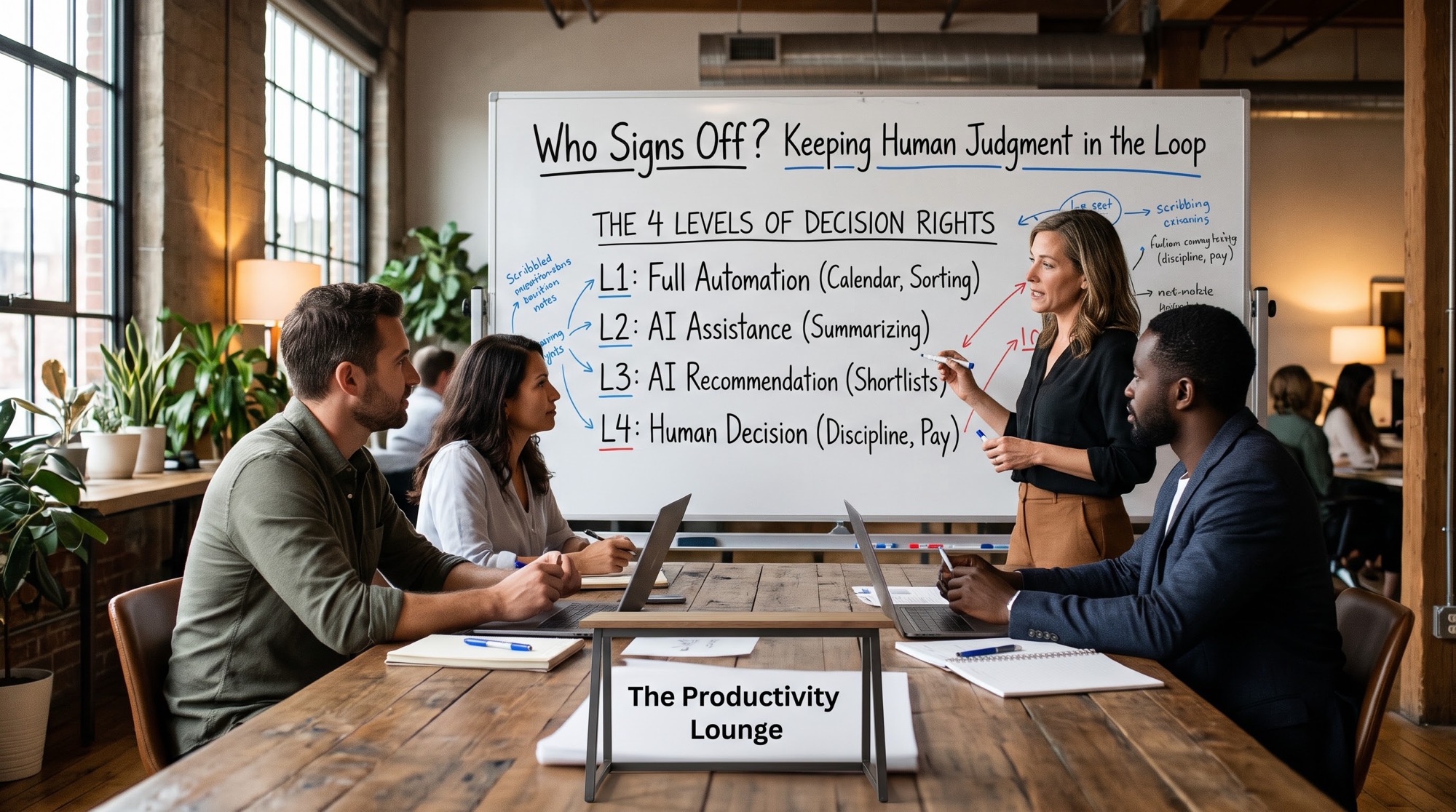
The 4 Levels of Decision Rights
Before adding an AI tool to any process, place the workflow on one of these levels:
Level
Control Type
Example
Operating Rule
1
Full automation
Calendar scheduling, data formatting, inbox sorting
Machine acts alone.
2
AI assistance
Summarizing 200 pages of survey comments
Machine speeds up discovery; human verifies and acts.
3
AI recommendation
Shortlisting candidates against a role profile
Machine filters and suggests; human weighs the evidence and decides.
4
Human decision
Discipline, terminations, discretionary pay
Machine organizes records; human brings judgment, empathy, and discretion.
Rule of thumb: Automate the scaffolding around the decision, never the decision itself.
5 Questions to Audit Any AI Workflow
Authority drifts quietly. Run each AI-assisted process through these checkpoints:
- What can the system do on its own? Stick to low-risk, repeatable tasks like meeting digests and routing routine requests.
- Where does human review happen? A manager clicking “Approve” without looking at the data isn’t oversight. It’s automation in a human costume. Real review needs clear criteria and time.
- What requires explicit human sign-off? Hiring, corrective action, pay changes, and policy exceptions get permanent hard stops, set before software defaults make them invisible.
- Who can override, and is it safe to? If a tool flags someone as a flight risk or rejects an applicant, can the line manager say “no” without fear of pushback? If not, the decision has already moved to the algorithm.
- Who is accountable? One sentence should never survive a leadership review: “The AI recommended it.”Algorithms can’t defend a decision to the board or comfort an affected employee. People can.
The AI Collaboration Charter (One Page, Not Forty)
Give managers a short charter they will actually read:
- Assistance over authority. AI drafts and recommends. People own outcomes.
- Healthy skepticism. Fluent isn’t the same as correct. Scrutiny scales with consequence.
- Clear override paths. Everyone knows how to set aside machine output.
- Context wins. Reorgs, market shifts, and personal leave outrank a model’s data point.
- Data boundaries hold. Confidentiality doesn’t bend for speed.
- Decision rights are defined upfront. Teams know whether to accept, adjust, or discard machine guidance.
Where Context Breaks the Model
Performance reviews. A tool scans project logs, chat activity, and tickets to draft ratings. The summary looks tidy, but it can’t see the engineer who spent three months quietly mentoring juniors, patching an unassigned vulnerability, or calming an undocumented client crisis. Human review isn’t a formality here. It’s where the real context lives.
Hiring. Screening tools are great at matching keywords. They’re far worse at spotting non-traditional career paths, transferable skills, and grit. Treat a model score as a gate instead of a sorting aid and you’ll filter out your best long shots in favor of keyword-polished mediocrity.
Automation bias
Critical agency
Passive click on “Approve”
Run a context audit first
Blind trust in clean, confident wording
Ask what data is missing
Authority shifts to the model
Independent human sign-off
Accountability without power
Accountability with authority
Result: fragile, ungoverned organization
Result: resilient team
The “Explain Before You Decide” Protocol
Automation bias is our natural tendency to trust articulate, confident-sounding output. The fix is one simple rule for high-stakes moments:
Articulate your own reasoning before you accept an AI recommendation.
Before approving, decision-makers answer three questions:
- What hard evidence outside the model’s summary supports this?
- What crucial context does the tool not have?
- Would I defend this decision if the model had recommended the opposite?
If the answer to #3 is “no,” stop. The tool is no longer supporting your decision. It has quietly replaced you.
Map It Before You Roll It Out
Workflow Step
Machine Role
Human Role
Final Authority
Data collection
Aggregate and index
Set constraints and sources
Human
Synthesis
Extract patterns, draft
Check accuracy and omissions
Human
Option generation
Propose 3 to 5 paths
Judge feasibility
Human
High-stakes action
Provide baseline context
Make the call, own the risk
Human
Communication
Draft
Refine tone and context, then send
Human
The takeaway: you rarely need to automate the decision. You only need to remove the friction around it.
Quick Diagnostic: Your Agency Footprint
- Can every employee tell which parts of their work are advisory and which are decisive?
- Is there a low-friction way to override an AI recommendation?
- Are managers rewarded for quality of judgment, not speed of rubber-stamping?
- Does the team know what data the tools draw from, and what they miss?
- If the tool went offline tomorrow, could the team still run the process?
Two or more “no” answers? You’re trading resilience for short-term speed.
The Lounge Question
Pick one AI-assisted workflow on your team. Find the exact moment a recommendation turns into an action.
What changed and why
Who owns that transition today?
Does that person have the context, the latitude, and the safety to say “no” to the system? Or are they signing off on a process they no longer understand?
If it’s the latter, you don’t have an AI adoption strategy. You have an operating-model failure waiting to surface.
The Productivity Lounge explores workplace design, leadership, and sustainable performance, helping teams use new technology while sharpening the human judgment that creates real value.