The smartest use of AI isn’t handing over your judgment. It’s giving your judgment a better starting point.
Something fascinating is happening in the workplace: we’re surrounded by tools that can write, summarize, analyze, recommend, organize, and even act on our behalf. The technology keeps getting more capable. And that raises a real question:
If AI can do more of the work, what should humans still be doing?
The easy answer is “the things AI can’t do.” That’s not quite right. The sharper question is:
Which parts of work require human judgment — even when AI can produce a perfectly reasonable answer?
That distinction will matter enormously in the years ahead. The future of productive work isn’t a choice between humans and AI. It’s learning to make the two work well together.
The Copilot Is Not the Pilot
The name gives it away. A copilot assists — navigates, monitors, supports the person responsible for the journey. A copilot doesn’t eliminate the need for a pilot.
Same principle at work. An AI assistant can draft a communication, summarize a report, analyze a spreadsheet, spot patterns, suggest interview questions, even recommend a course of action.
But before a recommendation becomes a decision, someone has to ask: Does this make sense? And more to the point: does this make sense here?
That second question is where context enters — and context is still your job.
AI Can Generate. Professionals Must Evaluate.
For years, the hard part of knowledge work was producing the first draft. Now AI hands you a decent one in seconds. That’s genuinely useful. It also creates a new responsibility: evaluating the output matters more than ever.
Say an HR manager asks an AI tool to analyze an employee’s performance and suggest a response. The output might look thoughtful. The manager still has to ask:
- What information was included — and what’s missing?
- Is it accurate?
- Is there organizational history the system doesn’t know?
- Are there policy considerations or competing explanations?
- What would happen if this recommendation were wrong?
The AI generated an analysis. The judgment call is still yours.
The Danger of the Plausible Answer
Here’s the underrated risk: an AI answer doesn’t have to be wrong to be dangerous — it just has to be plausible. A ridiculous response is easy to catch. A polished, confident one with a subtle error hiding in it is not.
That’s why AI literacy isn’t just about writing better prompts. It’s about interrogating what comes back:
- What evidence supports this?
- What assumptions is it making?
- What might be missing?
- What’s an alternative explanation?
- What would change my conclusion?
Ask those, and AI stops being an answer machine and starts being a thinking partner.
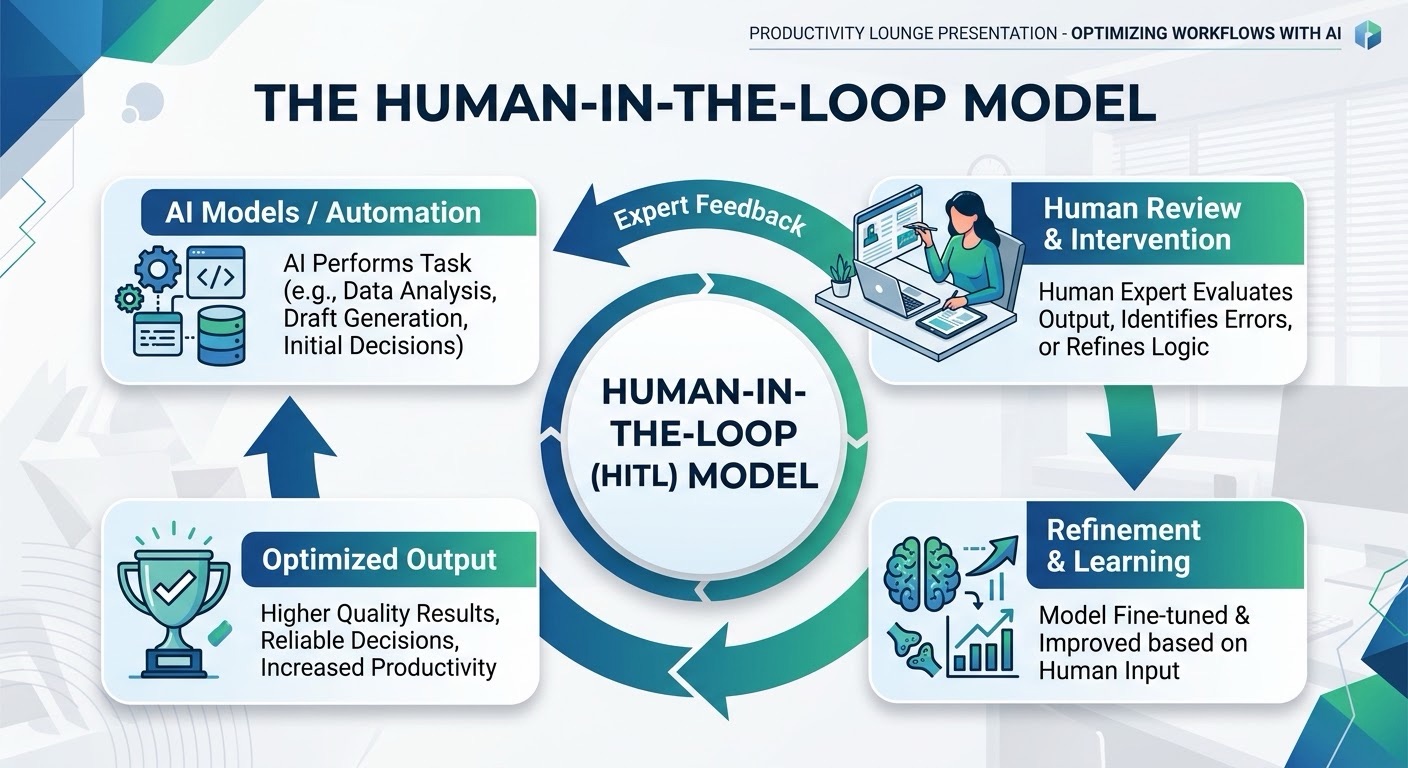
The Human-in-the-Loop Model
A simple seven-stage loop for AI-supported work:
- Ask — Define the problem before you touch the tool. Start with the question, not the prompt.
- Generate — Let AI produce options, analysis, or a draft. This is where it earns its keep.
- Examine — Check facts, logic, and completeness. Fluency isn’t accuracy.
- Contextualize — What does the AI know? What doesn’t it know? What do you know that never made it into the data?
- Challenge — Try to disprove the recommendation. Ask for the counterargument.
- Decide — The accountable human decides. Not because AI can’t — because accountability has to live somewhere.
- Reflect — After the outcome lands, ask what you learned. This is the step everyone skips, and the one that actually builds judgment over time.
Let AI Disagree With You
We tend to use AI to confirm what we already think. Convenient — and a missed opportunity. Try flipping it:
- “Here’s my proposed approach. Give me the three strongest arguments against it.”
- “What assumptions am I making that might not hold up?”
- “What information would you want before making this call?”
- “Give me two alternative explanations for this.”
Now AI isn’t just making work faster. It’s helping you think around the problem — which is worth more.
Four Levels of Human–AI Work
Level What it looks like Best for Human-led Human does the core work; AI assists lightly Sensitive conversations, relationship-building, high-context calls AI-assisted AI supports; human stays deeply involved Drafting, summarizing, research, brainstorming AI-led, human-approved AI does the heavy lifting; human reviews and signs off Repeatable processes with real controls in place Automated with monitoring System runs it; people watch and intervene Standardized, lower-risk tasks
No level is universally “better.” The right one depends on the task, the risk, and what it costs to be wrong.
Productivity Isn’t About Removing Humans From the Process
There’s a quiet trap in automation talk: the assumption that the ultimate win is getting humans out of the loop entirely.
Say an AI system cuts a task from two hours to ten minutes. Great — unless the ten-minute version produces decisions nobody understands, can’t explain, and gets wrong more often. You saved time. You didn’t necessarily create value.
Real productivity asks the bigger question: did the outcome actually improve? So measure more than time saved:
- Did quality improve?
- Did decisions improve?
- Did errors drop?
- Did the employee or customer experience get better?
- Did risk change?
- Did people get more time for higher-value work?
Efficiency is nice. Effectiveness is the point.
The New Professional Advantage
Drafting, summarizing, formatting, basic analysis, information retrieval, routine communication — these get easier to automate every year. That doesn’t make expertise less relevant. It moves where expertise creates value.
The edge now belongs to whoever knows:
- What question to ask
- What evidence actually matters
- What doesn’t add up
- What context changes the answer
- When to push back on the recommendation
- When to say yes, no, or not yet
That’s judgment. It’s not going anywhere.
A Five-Minute AI Judgment Check
Next time AI hands you an important recommendation, don’t accept or reject it on the spot. Run five questions first:
- Evidence — What supports this?
- Assumptions — What is it taking for granted?
- Context — What might be missing?
- Alternatives — What else could explain this?
- Consequences — What happens if it’s wrong?
Five minutes here can save hours — sometimes far more — later.
The Manager’s New Responsibility
This isn’t just an individual habit. Managers now need to actively teach teams how to work with AI, and “here’s the tool, have fun” doesn’t cut it anymore.
Try instead: “Here’s what this is good for, here’s where we need human review, and here’s what you should never accept without checking.”
That reframes AI adoption as capability-building, not a software rollout. We’re not just implementing a tool. We’re redesigning how people think and work — and that deserves more than a Slack announcement.
The Productivity Lounge Take
The goal isn’t humans competing with machines, and it isn’t humans passively rubber-stamping whatever the machine produces. It’s better than either:
Let AI handle the mechanical work so people can spend time on the meaningful work. Let it surface possibilities — let humans supply context. Let it challenge assumptions — let humans exercise judgment. Let it accelerate execution — let humans stay accountable for what actually happens.
That’s the human-in-the-loop workplace. And the most valuable skill in it won’t be getting AI to give you an answer. It’ll be knowing what to do once you have one.
Reflect Upon
When AI gives me an answer, am I asking whether it’s convincing — or whether it’s actually correct, relevant, and right for my situation?
That difference might turn out to be one of the defining professional habits of the AI era.
Think Better. Work Smarter. Live Well.
— The Productivity Lounge